
She said, “Pictures that need to be explained with words are fundamentally incomplete in themselves.” The last time I’d heard that was many years ago. The statement came from a “judge” at a camera club competition in Berkeley, California. At the time I thought the sentiment was questionable. In the years since, my views have matured. I now think it’s idiotic.
Words and images are twins, intertwined channels in the process of communication. Each has the innate capacity of informing and amplifying the other. However beautiful, touching, pleasing, frightening an image may be, words are often essential to provide cultural, environmental, historical, explanatory context. Now, there are times when it may well not be desperately needed, considering all the sunrise pictures, sunset pictures, backlit sheep pictures, kitten pictures and flower pictures that so often intrude on our consciousness. When I was still competing, the titles that most annoyed me were Rose #48, Petal #12, Summer Eve #26, Misty Morn #4, or Cloud #72. Or Untitled, which seldom works. In rebellion, I entered an industrial scene from the U.S. Naval Base at Mare Island, California, as Begonia #1,250.
To remove verbal explanations is to vitiate the work of artists, scholars, art historians, critics and many others. I owe them far too much to consign them to the unemployment line. I didn’t want to go on and on about this, but I did remind my friend of the many ways in which text contributes to images, not the least of which are curatorial statements that accompany virtually every museum and gallery exhibition, and the words I have written in my articles and books, which are essential to the understanding of the pictures, as words are in all art books. Our dialogue reminded me that an acquaintance, Dr. Mark Haworth-Booth, former Curator of Photography at the Victoria and Albert Museum in London, had written an entire and excellent book on a single image, the mid-19th century photograph River Scene, by Camille Silvy.
So let’s do an experiment. Here is a photograph titled Rail, or perhaps, Rail #11.
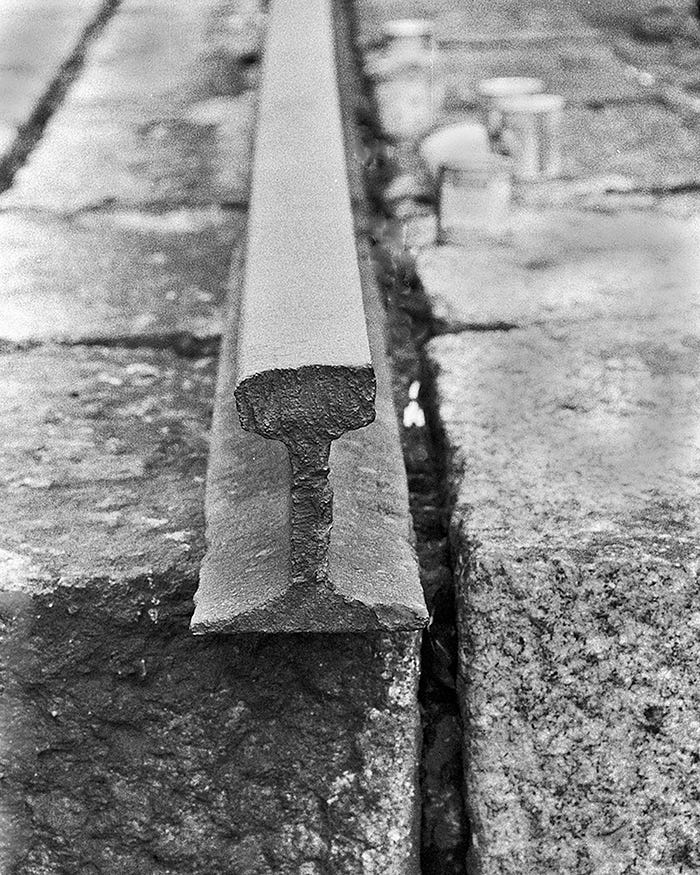
One can talk about composition, perspective, texture, exposure, railroad history, metallurgy, but what else is there?
Now let’s give it its true title, The End of the Line, Auschwitz-Birkenau.
I photographed this in 1994, for my book Liberating The Ghosts: Photographs and Text from the March of the Living, a documentary volume on a memorial pilgrimage by young people to sites of the Holocaust.
The rail comes to an abrupt end, its cross section somewhat anthropomorphic, just before the plunge into the dark chasm, the pit in which I was then standing. In a crevice to the right of the rail is a lit memorial candle. Further back are cans containing the remains of other, consumed candles.
Oxford-based photographic historian, Dr. Anne Hammond, wrote:
“This is a heart-breaking picture. The only plane of focus is that of the shape of severed metal, which in this view (rather than horizontal, as we usually think of it) becomes vertical, upright, like a figure standing. Like just one of the millions of figures standing behind him along that track. One can only hope that the End of the Line is the end of such inhumanity. Sadly, one sees it in other guises threatening to return in various forms around the world.”
Do words make a difference to the way we “read” images? Conversely, can you contemplate reading fiction, history, poetry, even maps, charts, mathematical formulas, without images — imagination — lighting up your brain?
Effective interpretation requires multiple sources. Pictures benefit from the illumination of words, and words benefit from the illumination of pictures.