
Over the years, I’ve come across so many Ansel Adams wannabes, Wynn Bullock wannabes, Michael Kenna wannabes and many others who’d prefer to be someone other than who they are. I’ve been drawn to the conclusion that imitation is the sincerest form of mindlessness.
I’ve managed to escape that. Though I admire the work of many artists in many media, I have neither icons nor mentors. My first art teacher was an idiot, and this did me sterling service. I was left on my own to pursue work as I wished, and as I could invent. And invent I did, drawing often from a long classical education, from a passion for literature and music, history and philosophy, as well as unorthodoxy, bloodymindedness, and a capacity to find joy in small phenomena that often escape the notice of others. As digital media have thinned the walls among art forms, so has my education blossomed.
From time to time I’ve been asked “How did you do that?” That’s actually an inquiry that tends to yield much less useful information than “Why did you do that?” The former is entirely mechanistic and limited, while the latter is considerably more thoughtful, more probing, more metaphysical, more likely to result in independent effort, and always much better teaching than requiring students to use carbon paper.
However, on this one occasion, I’d like to indulge those who ask the first question. Below, I include an image made from my love of the season, and below that, the recipe for achieving it. Its title is Autumn Colors.
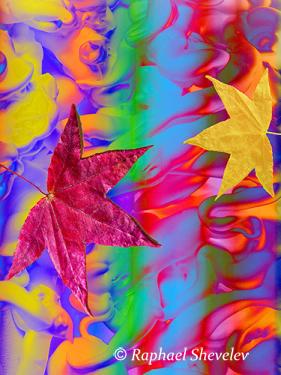
Take ten French colored pencils, a can of Gillette aerosol shaving cream, and a single autumn leaf. Mix the ingredients carefully until you find the right flavor, testing frequently. Using a trustworthy camera, add a pinch of powdered Photoshop, and a heaped tablespoon of imagination. Store for several nights in the occipital lobe, and when it has risen sufficiently, place in a warm monitor. Results may vary.
Pulitzer-Prizewinning novelist Jhumpa Lahiri, in her book In Other Words, writes of the great difficulty, as a mature adult, in acquiring a new language, in her case, Italian. She describes the years of study, the discipline, practice, receptiveness, imagination and devotion, and then adds an essential ingredient: “I renounce expertise to challenge myself. I trade certainty for uncertainty.” That’s the price and the intrinsic reward for learning a new language, or a new voice in an art medium, and continuing to refine the process, and, in the refining, changing direction, seeking refreshment.
There’s nothing intrinsically wrong with seeing the world through the eyes of others. After all, a lot of teaching and learning happens that way. But there is much to be said for also seeing the world through one’s own eyes.
What’s the point of standing upon the shoulders of giants if your only vision is downward?